
Showing posts with label animal. Show all posts

Monday, March 8, 2010

Virtual Field Trip: Croc Farm


When taking kids on a field trip, it is always best to do a head count. But since I took the 3rd, 4th and 5th graders from Akany Avoko to a crocodile farm, I thought it best to be thorough and do hand, finger, foot and toe counts too. And when all was said and done, we were all accounted for down to the very last toe.

And what did the excited Malagasy students learn at the crocodile farm? Well, why don't you tag along for a virtual field trip and find out?


Right, welcome to the Croc Farm. Make sure to stick with your buddy and no sharing your sandwich with the man-eating reptiles. Last chance, anyone need to tinkle? Good, let's get started.

Crocodiles are pointy-toothed time machines. That doesn't mean you can crawl inside one and zap yourself to the future. In fact, I would advise you to never crawl inside a crocodile. (Except for perhaps you, William.) Crocodiles are like a time machine, because when you look at one you are looking backwards 200 million years!

Dinosaurs saw the same kind of crocodiles that you see. That is because crocodiles are nearly perfect reptiles. Unlike Sally's spelling, there really isn't much room for improvement. They pretty much stay the same.

Most animals and plants change over time as certain genetic mutations and features work out better than the ones their parents and grandparents had. The new slightly different animals or plants do well and have lots of babies. Do that for millions of years and things can really change. But crocodiles don't really change anymore. They made all the right adaptations a long time ago.


Yes, Timmy?

"What are some of those adaptations that make them so perfect?"

Excellent question, but please take your finger out of your nose while I answer it. Thanks.

Well, for one thing check out that long, strong tail. That puppy is chock full of muscles. It can use it to gently swim through the water or ambush a poor defenseless bird that was just trying to have a little drink. Poor bird.

Their fat webbed feet aren't used for paddling. They are used to steer and to support their body as they walk, run and even hop on land. No small feat considering a large crocodile can weigh as much as a car.

They don't hunt down their food. They use their excellent camouflage (and patience) to wait for food to come just a bit too close before they ambush it and bite down with their world famous jaws.

A crocodile can really bite. I know Ruby, your little sister can really bite too, but she is nothing compared to a crocodile. Their bite is 5,000 pounds per square inch. Yeah, what does that mean. I get it. Well, let's compare it to another toothsome foe, the great white shark. That seal-eating super fish can only chomp down with a measly 400 pounds per square inch.

But with all those big muscles used to bite down, there aren't many left over to open the mouth back up, so a crocodile is a bit of a weakling too. Even you could hold a crocodile's mouth shut, Pete (even though you don't seem to be able to keep your own shut for more than two seconds).


Now let's shuffle over to the next pond.

Crocodiles are cold-blooded; just like math teachers. Just kidding, Mr. Weedle. Thanks for coming today and please put down that rock. Right, you are able to eat delicious food (or the food they serve in the cafeteria) and turn that food into energy and heat. That means you are warm-blooded. You pretty much stay at 37.5 degrees Celsius. Cold-blooded animals can't really warm themselves up. They have to get some help from the sun. Their blood can get hot and cold and it doesn't really hurt them.

Crocodiles can't sweat to cool off like you. So when they get a bit past toasty, they open up their mouths to cool off like a dog. They can take a swim to cool off too. To warm up, they drag their big bellies up onto a nice beach to catch some rays and maybe eat a wildebeest.

In Madagascar, there are some special crocodiles that have learned--eyes on me, Lester--to love the cold. They are the only crocodiles in the world that live in caves. Caves are cold. That means the crocodiles are cold. And when a cold-blooded animal gets cold, they get slow. And in the Madagascar cave crocodiles' case--sorry, head up and eyes on me, Lester--they get so cold they can't even eat. They have to get out into the sun to warm up enough to have a meal. It's not too much of a hassle though. Some of them only eat once a year. And during certain times of the--right, that's it! Mr. Weedle, would you kindly pick up Lester and feed him to the crocodiles?

Thank you.


Yes, Becky?

"Why does Lester get to play with the crocodiles and the rest of us don't?"

Because I like him best. Now let's move on.

Take a close look at the crocodile skin. It may look old, rough and clunky, but it's really top-of-the-line high-tech stuff. It has special receptors that allow it to feel even the tiniest movement in the water. And the scales are so tough and protective that some tribes in Africa even used the skin as shields. A crocodile's armored outer shell even helps on chilly mornings. There are thousands and thousands of small capillaries running with blood just beneath the thick bits. The scales absorb the sun's heat and transfer it to the blood. Nifty, no?

Simon?

"This is getting boring?"

Simon, you're getting an F for today, but you don't see me complaining do you?

Fine, I'll shut my trap about the wonderful world of crocodiles and we'll see what else the Croc Farm has to offer.


"Mr. Lebo, the ostrich looks angry."

Oh, it's probably just upset, because it can't fly. Or that it's so far from home. Ostriches never lived in Madagascar. They did have elephant birds though and they were almost twice as tall.


Here, you can see two very special turtles who appear to be in love or involved in some sort of turtle car accident. The little one in the midst of being run over is a radiated tortoise. One of them lived to be 188 years old making it the oldest known living animal. And the big one doing the running over is a Seychelles giant tortoise and it is one of the largest tortoises in the world. Madagascar used to be crawling with similar giant tortoises, but they became extinct shortly after people arrived about 2,500 years ago.

"Mr. Lebo, why would people be so mean to big lovable turtles?"

I don't know. Maybe because they asked too many questions.

Alright, that's it for blabbing. It's time for some fun. Take off your shoes and you can each have eleven seconds to enjoy the bounce and wonder of the trampoline...................... ...................................Excellent, fun is over.

"But you said we could have ice cream?"

I also said you wouldn't have homework this weekend. Do you believe everything I say?

Oh, for goodness sakes, stop crying or you can all go help Lester wrestle the crocodile.

"I almost got her, Mr. Lebo! Ouch. I think she's getting tired. Ow! Pointy teeth. So many pointy teeth. Ow!"

Good work, Lester. Now, while the crocodile finishes her snack, we can all go have some ice cream...if it will keep you from whining.


"Thank you, Mr. Lebo!"

Yeah, yeah.


Ok, it's the real Mr. Lebo here. Not the mean one from the virtual field trip we just took. I just want to let you know that the real thanks don't go to me. They go to Mrs. Schwimmer in Princeton, NJ for being ever so kind and loving by donating her own birthday money to help send the kids from Akany Avoko on a wonderful, wonderful field trip to the quite real Croc Farm. And, yes, we did get ice cream on the way home. And, no, none of the kids spilled it all over their nice clean shirts. I was the only one to do that.


If you are interested in sending the kids of Akany Avoko children's home on another cool field trip, please email me at chad_lebo@monet.prs.k12.nj.us to find out how.

Friday, February 19, 2010

Hey, Did that Stick Just Blink?

The wily, not to mention barky, leaf-tailed gecko.

There is good camouflage and then there is this fellow--the leaf-tailed gecko. I practically had to touch my eye my right up against her eye before I was even sure she had an eye. And this one wasn't even on a tree with bark. It was on a larger ginger plant, but it still blended completely in to look like just some part of the plant. 

If I was a fly, I would have been smacked by her tongue and scarfed up as a tasty snack for sure.

Proof. This is no hunk of bark. There are indeed eyeballs. Not to mention a big grinning mouth.

Check out the leafy eyelashes. That's attention to details.

The gray bit on the left is the tail and the rest are legs, feet and probably the world's weirdest toes.


Here's a little comparison. On the left is the bark of a nearby tree. Notice that the gecko's disguise even includes white spots to mimic fungus and mites. Crazy.

Tuesday, February 9, 2010

Here's Lookin' at You Kid...and You...and You...and You...

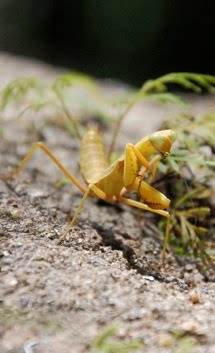
Look around all you want. You'd have a tough time finding a better set of eyes than a praying mantis. Correction, better sets of eyes. A praying mantis like this one from Andasibe, Madagascar, has more eyes than you can shake an optometrist at.


Like all insects, they have a pair of compound eyes. Those are the big bulgy ones you can see in the photo. Those black dots in the middle are not pupils. It's just an optical illusion. They don't have pupils or eyelids. Each one of those compound eyes is made of hundreds of little eyes, or lens.

But that is not what makes them such good lookers. They also have three simple eyes that can sense light and dark arranged in a triangle between their long antennae. Of course, most insects have simple eyes, so that's not so special either.

Here are the special bits.

A praying mantis is one of the few insects with stereoscopic vision. That's a fancy way of saying they can see things from two different angles like we do and pinpoint exactly how far away a tasty gnat may be buzzing.

"Hey, if we have stereoscopic vision too, why are praying mantises so special?"

Well, can you look straight ahead and read a book that's behind your left shoulder? A praying mantis can...as long as you teach it how to read first. They can see 300 degrees without even turning their heads.

But turn their heads they can. They are one of the few animals in the world that can turn their heads around and look straight behind them without moving their bodies.

Add that to all their eyes and the stereoscopic vision and you have yourself one fine little predator. Mosquitoes and flies don't stand a chance if they are unlucky enough to land nearby.

But it is not just annoying insect pests that get served up for mantis lunches. Large tropical praying mantises have been known to eat small lizards, birds, rodents and even snakes.

Let's hope they don't get any bigger.

Sunday, February 7, 2010

Boring Name but Cute Nonetheless

Allow me to introduce the common brown lemur. And since we have talked about lemurs before let me skip the old stuff and just mention what makes these "common" primates uncommon.


Well, for one thing they all look alike. The males and females look and weigh pretty much the same. That is rare for lemurs or any primate for that matter.

These are no night lemurs. They spend their days scouring the trees for food. But sometimes they do stay up late and hunt around in the night too especially when the moon is full. (Vampire lemurs perhaps?)

And what do they eat? Mostly fruit, but they won't turn down a tasty cicada or millipede if their 5-fingered hands find some (Oh come on, like you've never wanted to eat a millipede). They even nibble on dirt occasionally to get some extra minerals.

A lot of the plants the eat are full of nasty toxic chemicals that would kill many other animals. But common brown lemurs, and some other lemurs, have evolved to be able to handle all the poisons. That means they can eat the juicy leaves that others animals have to leave behind. Smart, eh?

There are not a lot of these medium-sized lemurs flying about the treetops, so they are considered near threatened. Their families have about 9-12 members, but no one seems to be in charge (try that with a human family of 9-12 and see what happens). And their families don't grow very fast. A mature female will only have one baby a year. There have been a few cases of twins too.

All these photos are from a wonderful little weekend away my wife and I just spent near Andasibe. We were lucky enough to lots of wonderful creatures besides these lemurs. I will put up a new post each day this week to show you everything from spiders to geckos.

Come back tomorrow and see whose next.

Monday, February 1, 2010

I Can't See the Forest for the…Hey, What Happened to the Trees?

The once tree-covered highlands around Ankafobe.


Madagascar is a weird and wonderful world of amazing plants and animals. Huge forests with towering trees and jumping lemurs. Giraffe-sized giant birds and tortoises as big as school desks roam around the hills. It is a paradise of life found nowhere else on earth.


Or at least that was true 2,500 years ago. But ever since pesky humans showed up, paradise has slowly been disappearing. Now there are very few forests or even trees for that matter. About 90% of the lush life-giving rain forests are gone. Those big birds and lumbering tortoises are extinct and so are many of the lemurs, fish, reptiles and other unique beasties that used to call the Red Island home.


There are still little bits of this once wild wonderland, but many of those bits are in trouble too. People cut down trees for houses and cooking fires they need to survive. And some people come and cut down the oldest and most beautiful trees like Rosewood to sell for lots of money. And if a tree survives the axes and chainsaws, it may not be safe yet. Fires rage around the country in many places.


Farmers burn trees and brush to make new fields for rice, beans and manioc. But fire can quite quickly get out of control and burn much more that just one or two soon-to-be fields. And without trees, the hard rains that pour down on the island for half the year can quickly wash away the good soil that used to be protected by the trees' sheltering canopy and thick roots.


This all means that it is very important to protect what forests still survive. Missouri Botanical Garden (MBG) is one of the groups trying to protect those survivors. And my wife, Dr. Cindy, is one of the scientists helping them.


These photos are from one tiny but special patch of forest that MBG is saving. It is only a fragment of what the forest used to be. But they are working hard to save what trees are left and plant new trees to make the forest bigger.


Does saving one little patch of trees make a difference? Well, just ask a Schizolaena bush.


"Hey, where in the world am I supposed to find a talking Schizolaena bush to ask?"


Well, to be honest, nowhere. Bushes don't talk. But if you want to find a non-talking Schizolaena bush, you will have to come to Madagascar. But not just anywhere in Madagascar. You have to come to a forest. And not just any forest. You will have to come to Ankafobe, this forest fragment that MBG is fighting to save. Every Schizolaena bush in the world lives in this one tiny forest. Only 100 bushes in a forest no bigger than 50 soccer fields.


That is what is called endangered. But then again, that's better than being called extinct.


One of the only 100 Schizolaena bushes in the world.

Awesome butterfly or awesome moth? Check the wings. Wings flat: moth. Wings up: butterfly. That means it's an awesome moth. Not all moths love the nighttime.

Ah, an old favorite...the eyeball leech. I did find it latched onto my hand, but it didn't even get near my peepers.

Replanting a forest takes a lot of trees. And all trees start as seeds. Local villagers run this MBG nursery that produced over 6000 saplings last year.

Saving a forest is more than just putting up keep out signs and planting a few trees. Local people have to have some way of making a living if they can't cut down the trees for money. Here is one wonderful way that MBG helps. This is a fish farm that produces fish that can be sold at nearby markets. It takes up less space than other forms of farming. It produces more money. It also generates compost that can be used for plants and vegetables. Sadly, a large rain the week before broke the damn and most of the fish were washed down into the surrounding rice paddies.

Monday, January 25, 2010

The See-Through Alien in Our Kitchen

Geckos are more than just cute insurance salesmen. They are amazing little lizardy beasties. They ring the world and live where ever there is a nice toasty climate. That's why you don't find any back in New Jersey, but I do find a lot here in Madagascar. And not only do I find the lizards in our house, at work, in the forest, almost every one I find lives only here on the lovely Red Island. About 92% of the reptiles here live here and only here. (That's nothing. A whopping 99% of the frogs are endemic.)


Check out some pics of a few geckos we've seen so far. If you are reading this with your class, please ask your students to raise their hand each time they hear something they didn't know before.

This little gecko and a few of his friends live around our house. This species seems to like the dark. But that's ok, because geckos' eyes are much better at seeing when the lights are out. And we love having them as house guests, because they eat the mosquitos that buzz around at night. They might see better than us, but we got them beat when it comes to eyelids. We have them; they don't. That means we blink when we need to keep our eyeballs nice and sparkly and moist. When they want to clean their peepers, they have to lick them. Watch the gecko in the Geico commercials. He usually licks his eyeballs once or twice.

This is the most famous of the Malagasy geckos: the day gecko. It is also one of the largest day geckos in the world. And, in case you haven't figured it out, a day gecko is not nocturnal. They spend their days hunting down insects, grubs, worms, etc.

Those fabulous feet. A gecko could make Spiderman jealous. Geckos can pretty much walk up, across or upside down on about anything they want. Maybe Geckoman vs Spiderman could be the next big comic? Spiderman could probably sneak in a punch or two when Geckoman was licking his eyeballs though.

Though this one wasn't blending into our bungalow very well, nocturnal geckos are masters of disguise. They can blend in with the best of them. Which is good for them and bad for their prey and predators. They cannot change color like chameleons though. But in case a predator does find them, they do have a few tricks up their sleeves. They can drop their tail and have it dance around and distract the would-be diner as they scurry away. They can also shoot out a stinky smell and even poo if the tail trick doesn't work. Yikes.

A see-through gecko friend in our kitchen. Though we didn't here a peep out of this little girl, we could have. Gecko's are the only lizards in the world that can make a sound other than "hissssss." They can bark and chirp for goodness sake.

[Photo by Bjorn Christian Torrissen]

My what hairy feet you have grandmother! A gecko may not look hairy, but its feet surely are. Each square millimeter (about the size of a big grain of sand) has over 14,000 hairlike things called setae. It takes about 20 or so of these setae to be as thick as a hair from your head. And the hair doesn't end there. At the tip of each of the setae are as many 1,000 even tinier hairs called seta. That means a grand total of about 14 million sticky hairs on each sand-grain-sized speck of foot. No wonder they can walk upside down on glass. NASA loves to study gecko feet to see if they can come up with a way for astronauts to walk on the outside of spaceships and space stations the same way.

Sunday, January 17, 2010

This Little Piggy...


...went to market,
This little piggy went home,
This little piggy had roast beef,
This little piggy had none,
This little piggy had a tungiasis infestation from a burrowed sand flea
and went "Wee, wee, wee" all the way home.


On the recent trip back stateside, my old students had lots of great questions about the people, places and customs of wild Madagascar...but mostly they just wanted to know about the creatures that had hatched out of my toe. Sadly, I didn't know exactly what they were. I know, what kind of science teacher am I anyway? Well, I can now proudly say that my little piggies had none other than sand fleas.

The flea in question: the sand flea.
[Photo taken from http://www.healthinplainenglish.com/health/infectious_diseases/tungiasis/index.htm]

I say piggies and not piggy, because just one day after I saw my students I awoke to a second lovely hatching. A little natural miracle right there under my right pointer toe. I thought I had a bit of black lint stuck under my toenail, but alas it was no bit of dress sock. It was Tunga penetrans aka chigoe flea, jigger, foot bug, sand flea or pico.

No matter what you call it, it is a parasite. They like to live in warm sandy soil like beaches. The mommy fleas like to attach themselves to a nice warm-blooded host like a cow, pig or me. They chew and digest their way through the outer layer of skin, but they don't crawl all the way in. Instead, they leave their little flea heinie (abdomen) sticking out. They use it like a snorkel to breath. It looks like a swollen bug bite with a black dot in the center. It doesn't hurt though, so most cows, pigs or, in this case, people don't notice when mommy moves in.

The black tubey thing is the flea's abdomen. The white eggy things are...uh, eggs.
[Photo taken from http://www.healthinplainenglish.com/health/infectious_diseases/tungiasis/index.htm]

In one or two weeks the female flea swells up to about the size of a pea with a 100 or so adorable little flea eggs. The eggs drop out of her heinie/abdomen/snorkel and fall to the ground. Then, sadly, the mommy dies and is eventually pushed out of the host's foot as it heals up. Meanwhile, the sweet eggs wiggle and hatch in about three or four days. They zip right through pre-school and the teenage years and in a mere two or three weeks they are crawling into feet of their own to lay eggs.

And since this whole life cycle rigamarole takes about a month and it has now been about a month since I've had any hatchings, I think I can safely say I am flea free. I do think I will be a bit more careful with my piggies next time I'm around warm, dry sandy soil though. I will be sure to wear my Scooby Doos.

(Oh, I may have forgotten to tell you that here they call flip-flops Scooby Doos. No, I have no clue why. And trust me, I've asked.)

My unlucky piggy. You can see the little black abdomen, but she did not get a chance to lay her eggs. There were eggs to be found, but they weren't quite ready for laying.
[The rest of the photos were taken by my slightly creeped out wife.]

A little cleaning and pruning with some toenail clippers to be sure all the wee beasties were gone and I was well under way to a flea free kind of life.

A little peroxide did the final cleaning. Don't worry, the bubbles are a good thing. It's the extra oxygen atom in peroxide (H2O2), being released when it hits the bloody and gooey bits of a wound. Oxygen may seem like a good thing, but too much at one time is poisonous to most germs.

Monday, November 16, 2009

♬♬♬ I Love You...You Love Me...We are One Big Happy Parasitic Family ♬♬♬


I have been in France for a few weeks now and have been enjoying many of the Paris sites.

And, as it turns out, the parasites have been enjoying me as well.

Sorry, that was a horribly bad joke, but I hope you got the point...I have been attacked by parasites!

That is a bit dramatic. The parasites didn't really attack, but they did certainly move in. And not only did they moved in. They had babies!

A few nights ago, I stepped on something hard on the bathroom floor. At least it felt hard. There actually wasn't anything on the floor. There was something in my foot though. I looked at the bottom of my foot and there was a big round bump with a hard black dot inside. I thought it was probably just an old splinter.

I got a pair of toenail clippers to cut it open and remove the splinter. When I did, I was in for a big surprise. There was no splinter, but there were lots and lots of eggs!

Tiny, tiny white eggs and plus some puss and blood and other gooey icky things. It didn't really hurt, but it was a bit weird. There shouldn't be eggs in my foot. Where did they come from? Who did they come from?

Well, I still don't know. I did my best to get rid of all the eggs. None of them hatched, so I didn't get to see what they would turn into. They are most likely some sort of parasitic worm. A bit like the caterpillar and wasp story a few posts ago.

Creepy, I know. Some worms like to live in humans. Sometimes they crawl into your feet and sometimes they get into your body some other way like sneaking in with a mosquito. They live in the mosquito and when the mosquito bites you it rushes out of the mosquito's mouth and into your blood. When it is older and is ready to have babies, it wriggles its way under your skin or through your blood until it reaches the bottom of your foot. It lays eggs. The eggs hatch and leave your foot for better places.

But every parasitic worm is different. Some live and grow inside of you until you become very sick or even die. Some live inside of you and don't hurt you at all. And some live inside of you and actually help you. Yeah, thank you parasites!

Parasites are all over, in and through you. Right now there is an army of billions and trillions of bacteria, worms, viruses and mites that calls you home.

Don't freak out. It's not really a bad thing. If they all took a vacation it would be bad though. You would get very sick. Your body needs that tiny army to keep it healthy.

In America, most people don't get the really bad parasites. The nasty parasites like to move from person to person in dirty water and disgusting mud. Where you live, you drink clean water, you wash your clothes and bodies in fresh water, and you go to the bathroom in sparkling bright little rooms.

In Madagascar, and other very poor countries, people don't have clean water to drink and wash with. And there aren't bathrooms like yours. This means that the nasty parasites are happy and healthy, but the people sometimes are not.

My parasites didn't seem to be too bad. My foot feels fine now and all seems to be good.

So, when you go to sleep tonight, don't forget to tell your trillions of tiny friends thanks for keeping you nice and healthy. And they will thank you for being such a nice warm home.

*If you want a fancy science word for two living things helping each other out, you're in luck. It's called mutualism.

Three of the tiny, tiny eggs. You would need about 8 to make 1 grain of rice.

This is one of the bad parasites. It is found mostly in Africa and it is passed along from unclean drinking water. To remove it you have to slowly wrap it around a stick until it comes out. Be patient. It might take a while; the worm can be 3 feet long! [Photo from www.fiveoclockbot.com]

This is one of the worst parasites. It causes Lymphatic filariasis. About 12o million people in about 80 different countries suffer from the parasite. [Photo from NY Times]

Thursday, November 5, 2009

Too Late for Caterpillar: A Creepy Science Bedtime Children's Tale


Caterpillar was a good larva. 


She loved to eat. 

She loved to eat. 

And she loved to eat. 

All that eating made her a nice and plumpy larva. And everyone loved Caterpillar. 

At night, Caterpillar dreamed wonderful little caterpillar dreams. She chewed her way through big plates of tasty green salad. She crunched a big munchy apple until there was nothing left but the tiny tippy tip of the stem.

And she dreamed too of one day soon curling up for a long, long nap inside of a cozy chrysalis. And of one day popping out as a beautiful, beautiful butterfly!

But Caterpillar wasn't the only one who dreamed. 

Flying and buzzing and darting around the garden was Wasp. Wasp liked to dream to. She dreamed of a warm safe place for her cute, cuddly wasp babies to call home.

But where could her adorable baby wasps live? 

Wasp was not good at building houses. And Wasp was very old. Wasp would not be buzzing and darting around much longer.

But her eggs! Her eggs need a home. They would hatch and their cold striped waspy bodies would need warmth and their tiny empty waspy bellies would need food. Wasp began to worry.

But then she saw Caterpillar

Warm, juicy Caterpillar. 

Uh oh, Caterpillar! Run Caterpillar run!

But Caterpillar could not run. She could only wiggle and wrinkle slowly along.

Poor Caterpillar. 

"Ouch," said Caterpillar. She felt a ting and a sting on her soft green back. 

Wasp laid her innocent little eggs.

Then Wasp whirled away into the blue, blue sky. She was sleepy. And soon Wasp laid her old and tired antennae down. She took a little breath, slept and never flew again.

Awwwwwww.

But her eggs would fly some day. 

The eggs were happy and toasty in their caterpillar-back beds. But you can't be a wasp egg for ever. 

Soon they wriggled out into the fresh clean air, their lovely larval heads happy to finally see the world. 

"Brrrrr! We are cold," they sang in their sharp larvaly voices. "And, oh, how are bellies rumble!"

"What can we eat?" they pleaded. 

"Pizza!" one little wasp replied.

"Don't be silly. There is no pizza here on this warm, juicy and delicious caterpillar," another little wasp snapped.

Still a third larva called out, "The warm, juicy and delicious caterpillar! We are standing on food. We were born on food. Mom laid us on a big globby mess of food!"

"Thank you, Mom," the little chorus sang.

All but one, whose tiny compound eyes filled with tiny compound tears at the thought of the dear and thoughtful mother they had never known.

Now Caterpillar did not like this idea one bit.

"I am not food!" she shouted. "Shoo you nasty waspies!"

But, sadly, wasps don't speak Caterpillar, so they did not understand a word. And they slurped and supped for days until their bellies nearly burst.

Then something weird started to happen. Big white hairs started to appear here and there and nearly everywhere. The hairs were coming from them and the hairs were warm. Soon the larva grew sleepy in their cozy sweaters. 

Then they too dreamed. They dreamed of flitting and flying in the breeze. And of one day laying their own eggs on their own juicy caterpillars and their hungry babies thanking them for a nice home and a wonderful supper.

The hairs kept growing and growing and soon the Caterpillar was lost in a big puffy cloud of sleeping pupas dreaming their precious waspy dreams. 

Caterpillar did not care for this at all, but Caterpillar was cold and tired and could not do anything but sleep and sleep until she could sleep no more.

Awwwwwww.

Then one day, there was a wiggle and jiggle and a turn and toss. And soon there emerged a small baby wasp. 

Then another and another. 

They dried their wings and whizzed away. 

The wide sky now their home and the once juicy caterpillar far, far below.


The End